The Bible Book Exodus - Bible study by verse and Encouragement
The Book of Exodus is the second book of the Bible, tracing the story of the Israelites' deliverance from slavery in Egypt, their journey through the wilderness, and the establishment of God's covenant with them at Mount Sinai. It highlights the themes of redemption, God's divine presence, and the Law.
Chapter
Chapter 1 of the Book of Exodus marks the transition between the history of the patriarchs (Genesis) and the beginning of the oppression and journey to liberation of the people of Israel.
The multiplication of Israel (Verses 1–7):
The text begins by listing the names of the sons of Jacob (Israel) who went down to Egypt. God knows His children, whether they are numerous or not. God repeats the names of His children many times to emphasize the interest He takes in them and the desire for future generations to become familiar with Him.
This family began with five people back in Haran: Jacob, Rachel, Leah, Zilpah, and Bilhah. Blessed by God, the family of Israel grew rapidly during their years in Egypt.
THE LEADERS WILL DIE – Parents and leaders eventually die; this is the way of life on earth. Those upon whom we depend greatly will one day depart. Be patient with your parents and grandparents; the only certainty we have is that one day they will leave. One generation passes for another to take its place; this is true for the people of God and for the people of the world.
Even though the men God chose die, He cares for the children who remain. THE CHILDREN OF ISRAEL INCREASED GREATLY. – God promised Abraham that He would multiply his offspring (Gen. 12:2; 15:5; 17:1–8), and here in Egypt, that promise was fulfilled. When Israel left Egypt, the total count was about 600,000 men, in addition to women and children (12:37). Naturally, this numerical increase soon caught the king's attention. A lesson we must not forget is that when God makes a promise, He keeps it, even on foreign and hostile soil. Even if the surrounding situation is unfavorable, when God moves, no one can stop it.
Exodus 1:8-11
THE GROWING BOLDNESS OF EVIL
Joseph’s role in preserving Egypt was appreciated by his contemporaries. Now, a new dynasty had assumed power in Egypt. The new king knew nothing of Joseph and had no interest for Egypt’s past.
To forget Joseph also meant forgetting God. Pharaoh set his heart and mind against Jehovah. ANYONE WHO SETS THEIR FACE AGAINST GOD WILL FACE MISERY. So, Pharaoh began his plan with:
THE GENERAL OPPRESSION OF THE GOOD – (v. 9) – Wicked men seek reasons to justify their ways before others and in their own eyes. This new king exaggerated the situation by claiming the people were "too numerous and too mighty for us." God’s favor upon the people stirred up the king's jealousy. There is no evidence that Israel harbored warlike intentions, yet it is astonishing what evil the carnal mind can read into the intentions of others.
CALCULATED CRUELTY – Verse 11 states that the Egyptians appointed taskmasters to oversee the people's labor; these men were notorious for their tyrannical methods. They subjected the people to inhumane working conditions while simultaneously forcing them to pay exorbitant tribute. Yet verse 12 notes: THE MORE THEY AFFLICTED THEM, THE MORE THEY MULTIPLIED AND GREW. When God intervenes on behalf of His people, the wicked schemes of men do not succeed.
THE COVERT MURDER OF THE INNOCENT – Seeing that Israel continued to multiply even under harsh slavery, the king decided to strike at the source of their strength: the male infants. To avoid public scrutiny, he enlisted the cooperation of the HEBREW MIDWIVES to kill the baby boys at birth. Perhaps these midwives were Egyptians assigned exclusively to the Hebrews. It is possible that they were leaders of a group of midwives, given that two women could not have handled the needs of all Israel. That plan would have put an end to Israel as a nation.
But once again, God thwarted the king's intent. These midwives feared God and did not obey the monarch's order. The influence of the Israelite faith was effective among their neighbors. FAITH IN GOD EMPOWERS PEOPLE TO AVOID DOING WRONG.
THE TOTAL AND BLATANT DESTRUCTION OF LIFE — When people fight against God, they descend into desperation. Pharaoh ordered the babies to be drowned in the river. But God protects His people.
Exodus 1:17

- When midwives had to choose between fearing God and obeying the orders of the king of Egypt, they chose to fear God. How will you react when faced with a choice between pleasing man or obeying God? Midwives were rewarded with families, not for the explanation they gave, but because they feared God.
Exodus 2:3
MOTHERS WHO INSPIRE
Moses was born during a difficult time for the people of Israel; an order had been issued to kill all male infants. Pharaoh had reached a state of desperation. He had first tried to oppress the people with hard labor, then he attempted to use the midwives who refused to follow his plan and finally, driven in part by Satan, he conceived this wretched and cruel idea.
Moses was not the couple’s first child; his sister, Miriam, was old enough to look after her brother. There was also Aaron, who was three years older than Moses (Numbers 26:59).
The parents' faith is clearly illustrated when the mother, seeing that the child was beautiful, hid him for three months. Afterward, she placed him in a small basket and left it by the riverbank. FAITH ALWAYS LEADS TO ACTION, EVEN WHEN THAT ACTION IS RISKY. In living by faith, the mother also demonstrated great intelligence. She placed the baby in a spot along the river frequently visited by the Egyptian princess, and she positioned her daughter at a strategic point to act at the right moment. It was also an act of faith for this Hebrew woman to entrust her son to the hands of an Egyptian princess. Like Hannah and Mary would later experience, this mother was convinced that her child was chosen by God, and she was willing to surrender him to divine providence. Yet, Jochebed acted with faith and as we might say, a "cool head", avoiding the trap of being led solely by sentiment. I know women who would rather die while holding their children close than find the courage to let them go even when doing so is the only way to save them from death.
And it worked! The grace of God was revealed through the compassion of Pharaoh’s daughter. Even when wicked men do their worst, God, through His gracious power, places goodwill and love in the hearts of those close to the tyrant. Little did the wicked king know that God was carrying out His plan right under his nose. It is also interesting that Moses' own mother was paid to care for him, paid with Pharaoh's own money. This is another example of how the wrath of man is made to praise God.
THE TOTAL AND BLATANT DESTRUCTION OF LIFE — When people fight against God, they descend into desperation. Pharaoh ordered the babies to be drowned in the river. But God protects His people.

Notice this mother’s initiative. She "conceived... gave birth to a son... saw that he was beautiful... took a basket... and put the child in it" (Ex 2:2,3). These actions denote a woman of courageous faith and clear goals. Its motivation and results are clarified by the author of Hebrews (Heb 11:23-27). She circumvented the law that ordered her to kill her baby: by placing him in the Nile River, she fulfilled the law (Ex 1:22); By surrounding him with protection, including placing her sister to watch over him, she demonstrated faith (Ex 2:3-4).
Today's minds cannot comprehend the terrifying tactics of the ancient Pharaohs. Idolatrous and corrupt, they felt nothing but contempt for Yahweh, the God of the Israelites, their enslaved social victims. Hatred, hostility and hard work were facts of life.
Jochebed serves as a model for women today with her contagious courage to fear God rather than men, and with a firm faith in promises and divine providence. Jochebed took her role as a mother very seriously, she raised her children in the Lord with conscious dedication. Certainly, she was the greatest influence before God in preparing these children for the great task that the Lord had for each one in leading and freeing his people from slavery.
Exodus 2:11–15
A study of Exodus 2:11–15 reveals the dangers and consequences of acting on our own initiative before we are spiritually and emotionally prepared for the purpose God has for us.
In this passage, Moses witnesses the oppression of his people, attempts to resolve the situation through his own strength, commits murder, and ultimately flees into the wilderness.
Verse 13-15 tells: When he went out the next day, behold, two Hebrews were struggling together; and he said to the man that did the wrong, “Why do you strike your fellow?” He answered, “Who made you a prince and a judge over us? Do you mean to kill me as you killed the Egyptian?” Then Moses was afraid, and thought, “Surely the thing is known.” When Pharaoh heard of it, he sought to kill Moses.
When We Act Prematurely
1. Having the right intention is no substitute for the right timing
Moses already felt the calling in his heart to be the deliverer of his people (Acts 7:25 makes it clear that he assumed his fellow Hebrews would understand that God intended to use him). While his desire for justice was righteous, both his method and his timing were flawed. When we act on the impulse of our own will, we turn a divine calling into a human disaster.
2. The flesh produces sand; the Spirit produces fruit
Moses killed the Egyptian and hid his body in the sand. In the Bible, sand often symbolizes instability and human works. Actions taken in the strength of our own flesh must be concealed; they breed fear and, sooner or later, are brought to light. When we act before we are prepared, we attempt to "hide" our mistakes, hoping no one will notice—but the truth always surfaces.
3. Lack of recognized authority
When attempting to break up the fight the following day, the Hebrew man questions Moses’ authority: "Who made you a prince and a judge over us?" Spiritually, Moses did not yet bear the seal of God’s authority.
Wait for your calling to mature: Feeling a desire to lead, start a business, get married, or begin a ministry is excellent. However, ask God whether you already possess the emotional and spiritual framework to bear the weight of such a responsibility.
Exodus 2:16
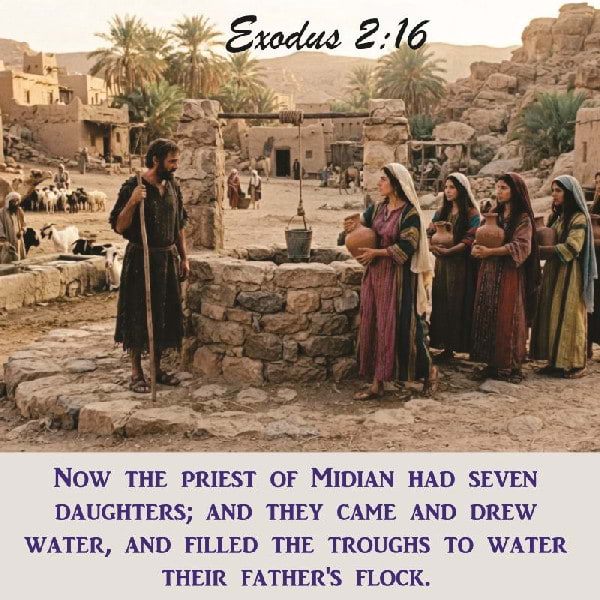
MOSES IN MIDIAN – The Midianites were descendants of Keturah and Abraham (Genesis 25:1–4). They lived in the vicinity of Mount Sinai, a mountain also known as Horeb (Exodus 3:1). The priest of Midian was named Reuel, which means "friend of God." In other parts of the text, he is referred to as Jethro. He had seven daughters who tended their father’s flocks, but they often faced difficulties due to other shepherds who mistreated them. Moses, always ready to assist the vulnerable, stepped in to help them. As a result of this kindness, Moses found a home and a wife. It was here that he became a father for the first time in a foreign land; he named his son Gershom, a name that implies not merely being a stranger, but also signifies exile or banishment.
During the time Moses spent in Midian, the oppressed people in Egypt felt the crushing weight of slavery even more intensely. Although the Egyptian leaders had ceased the killing of newborn boys, they continued to hold the people in cruel servitude.
Yet, God does not forget His own; He heard the groaning of the people. God delayed their deliverance until both Moses and Israel were ready. Moses required the discipline of the wilderness, and Israel’s longing for freedom needed to grow. God hears the cries of His people, but He waits for the "fullness of time" to bring about a victorious response.
God acts according to His purpose, not according to our anxiety. Even before the people cried out for help at the end of chapter 2, God was already working behind the scenes to provide an answer. Earlier in that same chapter, Moses was born, protected, and prepared—both within the palace of Egypt and in the wilderness of Midian. The process of shaping a deliverer took 80 years. God did not want to provide merely temporary relief; He was preparing a definitive deliverance. Often, the "delay" is the time God takes to shape the framework that will sustain our victory.
The Context of Moses (Divided into three 40-year phases)
• Ages 0 to 40 (In Egypt): Raised as a prince in Pharaoh’s court after being rescued from the waters of the Nile, he received the finest Egyptian education. After killing an Egyptian overseer while defending a Hebrew, he fled into the wilderness.
• Ages 40 to 80 (In Midian): He lived as a shepherd, married Zipporah, and worked for his father-in-law, Jethro.
• From age 80 onwards (The Call): In the midst of his daily work in the fields, God called him.
Key Lessons from the Call
• God calls within the ordinary: Moses was not in a temple or participating in a ritual; he was tending sheep as part of his daily work routine.
• Empowerment comes from God: The call does not depend on the natural abilities of the person being called, but rather on the presence and power of God ("I will be with you").
• Dealing with ego and fear: Moses’ journey illustrates a transition from a self-confident man at age 40 (who acted on his own strength) to a man who, by age 80, had become dependent on God.